 Before
 After · 16 wk

A home program for kids 5–12 with flat feet, rolled ankles, slouching, or tech neck. Just 25 minutes a day.
Prefer PayPal? Email support@posturekidsclub.com before purchase.
You've been noticing something. Everyone says it's fine. But you can't unsee it.
What you've been noticing:


If you're nodding — you're in the right place.
See how it works ↓
These families were exactly where you are.
Before
After · 16 wk
 Before
 After · 16 wk
 Before
 After · 8 wk
 Before
 After · 8 wk
 Before
 After · 12 wk
 Before
 After · 12 wk


No child's photo or story is published without a parent's written consent.
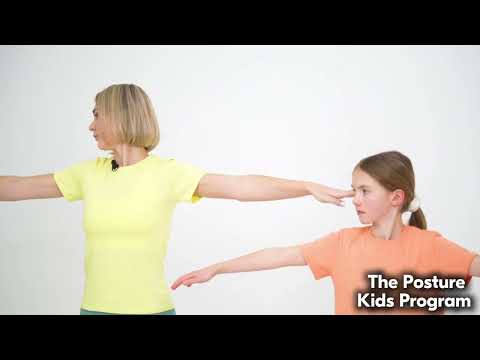
Try it together.
You'll know after the first session.
9 ready-to-go routines — each day you know exactly what to do.
Not a library of 40 exercises to sort through. A complete step-by-step track, built to progress week by week.
Bonus guide
Home Setup Check
The approach
Most approaches treat the symptom.
This one addresses the cause.
The root cause isn't in the feet.
Flat feet, rolled ankles, and slouching are how the body responds to the way the brain maps posture. It's a nervous system pattern — not a local foot problem. Treating only the feet doesn't change the pattern.
Insoles and massage don't fix it.
Insoles switch the foot off — they remove the signal instead of retraining it. Massage helps, but only as part of a bigger system. Without retraining movement patterns, nothing holds long-term.
Under 12, the window is still open.
The nervous system at this age is still forming. With consistent, targeted movement, the body can genuinely re-learn how to hold itself — not just compensate.
This program is built around that window — and that mechanism.

Your doctor isn't wrong that it's common. But common doesn't mean you have to wait it out. And "wait and see" isn't the only option.
— Elena Zaryaeva
Prefer PayPal? Email support@posturekidsclub.com before purchase.
14-day full refund guarantee
What moms are saying
Every message below is from a real parent who bought and used the program. Names adapted for privacy.
"If we do the exercises — no headaches, no leg pain. If we skip — it comes back. My son noticed this himself."
I bought the course fast, on impulse. My son had terrible headaches. Painkillers weren't working, we'd done an MRI. I took the iPad away and we started the exercises. Now he's so much better. The pain is almost gone. And his legs below the knee — which used to ache constantly — those don't hurt either.
— Rachel, mom of a 9-year-old son
"At first my son kept walking up to the iPad to check how much time was left. Three months later, the workouts just fly by."
25–30 minutes felt like forever to him in the beginning. He was counting every second. That was 3 months ago. Now we're regular — in October we hit 20+ sessions. Not perfect every day, but it's part of our life now.
— Olga B., mom of a son
"Three lessons in and I knew: this is exactly what I was looking for."
I teach yoga to children myself, and I'd been searching for precise tools like these — picking up bits and pieces from everywhere. This is a treasure trove. The approach is very close to mine — precise, consistent, gentle, no fluff, done with love and care. 👍
— Helena, children's yoga instructor
Questions
This is actually one of the most common worries parents have.
Most children naturally choose comfort, screens, and easy dopamine first, not because they are lazy, but because that is how the brain works.
And if we keep waiting for children to suddenly want to exercise on their own, very often the habit of movement never fully develops.
That is why the goal at the beginning is not perfect workouts.
The real goal is helping the child gradually build consistency, resilience, and a healthy relationship with movement over time.
The routines are short, around 25 minutes, structured, and designed to feel manageable rather than overwhelming.
Many families begin by doing the routines together. And over time, children often become much more willing to participate once movement starts feeling familiar and their bodies begin feeling stronger and more stable.
And especially with older children and teenagers, we often encourage parents not to focus on constant correction or pressure, but on creating a calm, consistent environment where movement simply becomes part of normal life.
Not necessarily.
For younger children, we usually recommend doing the routines together for at least the first couple of weeks simply to help build consistency and make movement feel like a normal part of home life.
But especially with older children and teenagers, many kids actually do better when they are given a bit more independence and can simply follow the videos on their own.
And honestly, at the beginning, the most important thing usually is not perfect technique.
It is helping the child build a consistent movement habit and gradually increase healthy movement volume over time.
Very often, once movement becomes more familiar and the body starts feeling stronger and more stable, technique and movement quality improve much more naturally.
At the same time, if a family feels they need more individual guidance, additional support can also be arranged through posture photo analysis and video feedback on exercise technique.
No — it works alongside it. Physio appointments are occasional. This program gives your child daily practice at home, which is exactly what clinic visits can't provide.
25 minutes. That's the full session — warm-up, exercises, and cool-down. Designed to fit into a normal family day, not replace it.
Some movement patterns are actually considered a normal part of development in early childhood:
At those ages, the nervous system and movement system are still developing balance, posture control, stability, and mature walking patterns.
The problem usually happens when the body stays stuck in those earlier movement patterns much longer than expected.
And while children continue growing, growth alone does not always teach the body better posture, stability, or movement organization over time.
In many cases, if nothing changes in the way a child moves, the same compensation patterns gradually become more reinforced:
Some children do partially improve naturally as they grow.
But very often, without structured movement support, the body simply grows while keeping the same movement patterns.
That is why we usually recommend not simply waiting, but gradually helping the body build more mature and stable movement organization while the nervous system is still highly adaptable to change.
After 12, posture and movement patterns usually become more reinforced over time, especially during puberty and rapid growth.
That is why changes often happen more slowly than they do in younger children.
But it is absolutely not too late.
At this age, we still very often see meaningful improvements in posture, walking patterns, coordination, body awareness, and overall movement control when the body starts getting consistent movement support.
And honestly, with teenagers, the biggest challenge is often motivation rather than the body itself.
That is why we usually focus much more on consistency than perfection.
It is far more important that a teenager keeps moving regularly, even imperfectly, than trying to make every workout look perfect from day one.
That's actually a really important question.
The program is not built around completely different exercise systems for every individual "diagnosis."
Very often, things like toe walking, flat feet, knock knees, rounded posture, forward head posture, low muscle tone, and poor coordination are not completely separate problems.
Very often, they are different signs that the nervous system and movement system are still functioning at a less mature developmental level.
That is also why many of these patterns are considered completely normal in younger children, like toe walking at 2 to 3, flat feet in toddlers, and knock knees in early childhood.
At those ages, the body and nervous system are still developing balance, walking organization, posture control, and stable movement patterns.
The problem usually happens when a child stays stuck in those earlier movement patterns much longer than expected, and we continue seeing the same compensation patterns at 6, 8, 10, or 13 years old.
So instead of treating every symptom as a completely separate issue, we gradually help the body move toward more mature and organized movement patterns through balance, coordination, posture control, body awareness, mobility, core and glute activation, and whole-body movement integration.
That is why the program is structured as a progressive movement system rather than a random collection of isolated exercises for individual symptoms.
The program can absolutely be supportive for some neurodivergent children, including children with autism, ADHD, and sensory differences, but it is very important to understand that every child is different.
For many children, this kind of movement work can help improve:
At the same time, children with stronger sensory sensitivities or more severe autism may struggle with certain exercises, stretching, touch, or structured body work.
And very often, the biggest challenge is not the exercises themselves, but whether the parent can realistically organize this kind of work at home without constant stress or resistance from the child.
In some cases, children may do much better with additional support from a specialist experienced in sensory and neurodevelopmental needs.
That is why we always recommend looking not only at the diagnosis itself, but at the individual child, their sensory profile, and how they respond to movement and body-based activities.
For many neurodivergent children, the goal of this work is not perfect posture, but helping the body feel more stable, organized, comfortable, and supported in movement over time.
And if you are unsure whether the program would realistically fit your child's needs, you are always welcome to contact us and describe your situation in more detail: support@posturekidsclub.com
14-day full refund. No questions.
Yes — a small set of simple props. Everything is affordable and easy to find:

Balance cushion · Bean bags · Yoga block · Loop & flat resistance bands · Foam roller · 2 tennis balls · Plus: paper, pen, pencils, straw, cotton pad, 2 chairs
The exercises are low-impact and designed specifically for children. They follow a careful progression — starting gently and building over time. Elena has been developing and refining this approach for over 20 years.
YouTube routines are generic and one-off. This program is structured in stages, built specifically around how children's nervous systems respond to movement — and designed to be done consistently over time, not once and forgotten.
Prefer PayPal? Email support@posturekidsclub.com before purchase.
14-day full refund guarantee
One more time
Your doctor said wait and see. You've been waiting. Now do something that actually changes it — 25 minutes a day, from home.
Choose your plan →